


The manufacturing process of titanium tees
View More
If you're sizing titanium stub ends, you're probably focused on the right things: material grade (TA2, TA10, or Gr7), bore size, pressure class, and whether the backing flange ring should be carbon steel or stainless. All valid.
But many leakage and deformation problems trace back to a parameter that often gets skipped: whether the stub end thickness is sufficient to resist shear at the root.
This article focuses on that one point. No welding procedure, no gasket selection—just the relationship between stub end thickness and root shear strength.
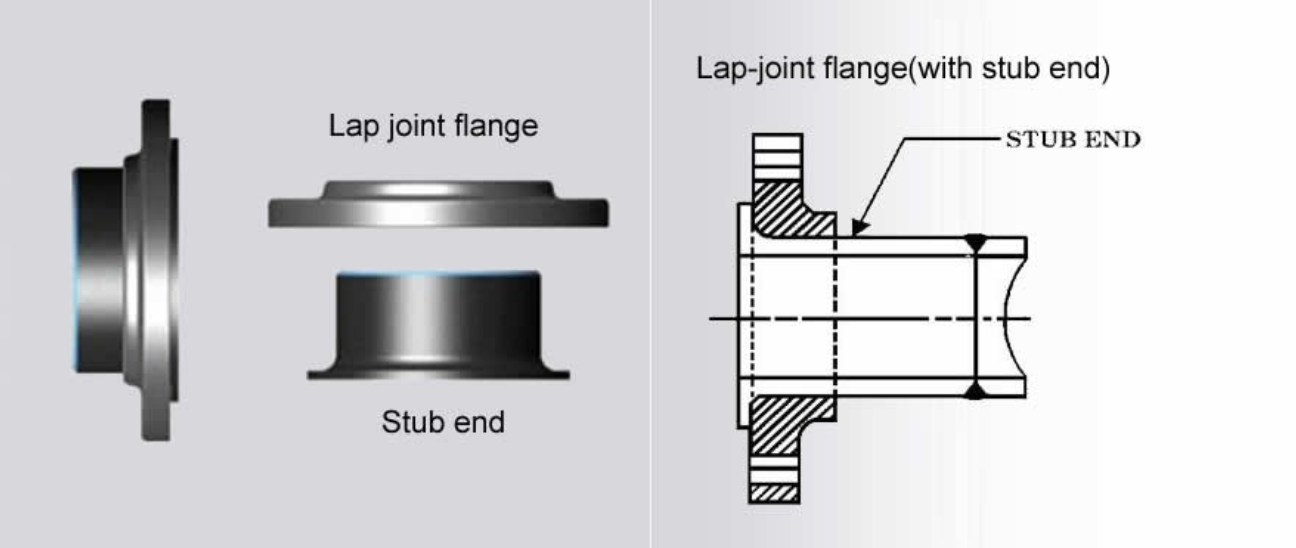
The Weak Point Isn't the Sealing Face—It's the Root
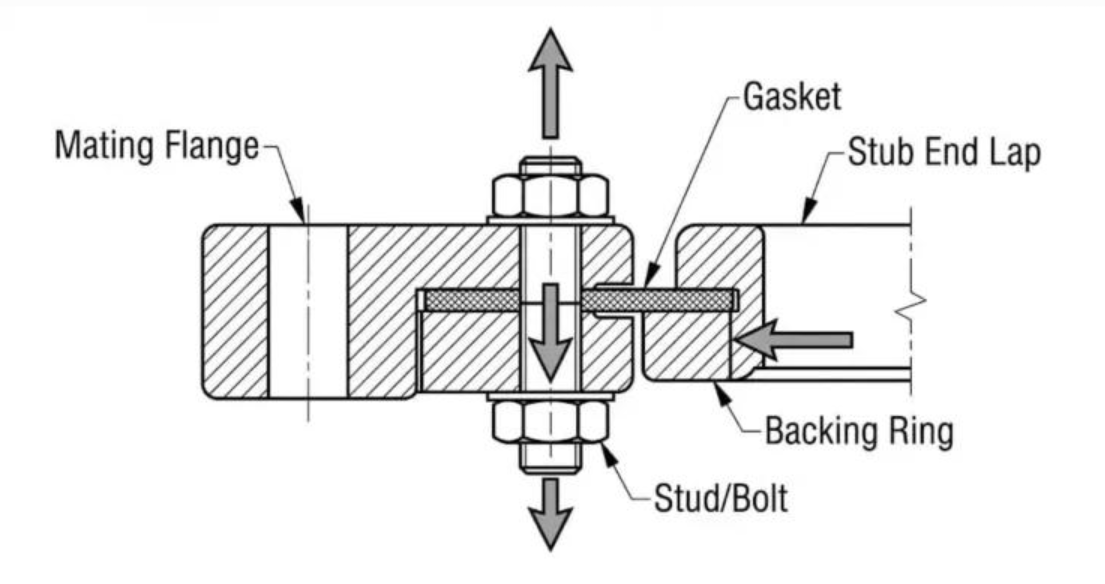
Titanium stub ends are typically used with lap joint flanges. The media only contacts the titanium stub end; the backing ring can be carbon steel or stainless, which significantly reduces cost and allows the flange to rotate freely for bolt alignment during assembly. The configuration itself is sound.
The problem lies in the load path. When the bolts tighten the backing ring, the ring presses the stub end's lap tightly against the gasket. The root of the stub end—the transition zone between the lap and the pipe barrel—experiences shear force. If the stub end thickness is insufficient, this region yields in shear first, followed by leakage or deformation.
Per ASME BPVC Section VIII Division 1 requirements for lapped flanges, the stub end—under both preload and operating conditions—must have its root shear stress limited to 0.8 times the allowable stress of the material. Stub end thickness directly determines the magnitude of this shear stress. In other words, thickness is not a "close enough" dimension—it's a safety boundary defined by an explicit formula.
Why "Looks Thick Enough" Doesn't Mean "Passes the Check"
Here's an engineering reality that's easy to overlook: integral stub ends are limited by forming capability—they can't be made arbitrarily thick, and you can't thicken the root independently of the pipe barrel.
For stamped or spun-formed stub ends, thickness changes during forming, and the root region may thin out. If sizing is based only on "estimating" stub end thickness from the pipe wall thickness—without running a shear check—a typical failure mode emerges: hydrostatic testing looks fine, but once temperature or pressure fluctuates in service, the root deforms slowly and eventually leaks.
This is especially true for high-pressure service. The stub end root is inherently the weak link in the connection. High-pressure applications require targeted thickening of the root wall to improve stability. This isn't something that "selecting the next wall thickness up" solves automatically—it requires going back to the shear stress formula and running the check.
Three Things to Confirm When Sizing
① Has the stub end thickness been checked separately for shear?
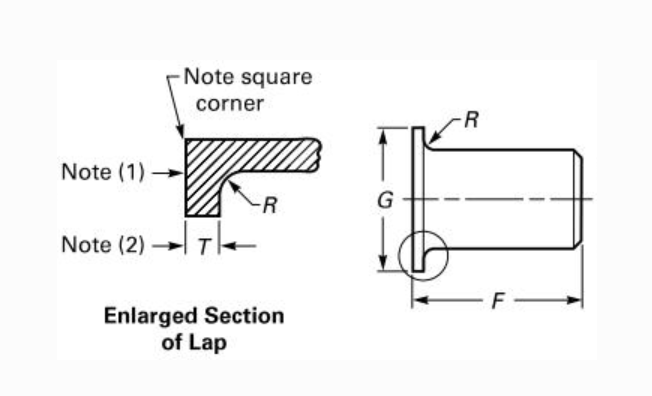
Don't accept "same as the pipe wall thickness" as an answer. The allowable stress of the stub end material (typically plate) and the pipe material (pipe or coil) may differ. If the stub end material has a lower allowable stress than the pipe, the check must use the stub end material data—not the pipe data. Stub ends manufactured to ASME B16.9 (long pattern) or MSS SP-43 (short pattern) are generally exempt from separate calculation when standard materials are used; however, once a non-standard material is used (e.g., TA9, TA10, Gr7), the lap ring / stub end must be checked separately. Titanium stub ends frequently involve exactly these non-standard grades—pay close attention to this point.
② Long pattern or short pattern—decide together with the backing ring and available space.
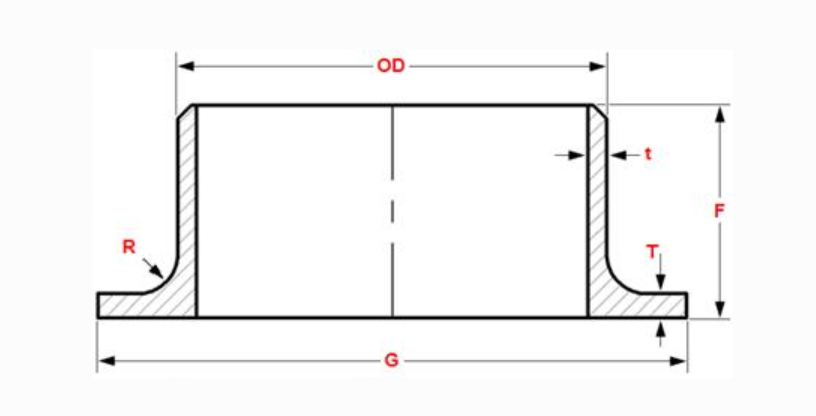
Stub ends come in two systems: long pattern (ASME B16.9) and short pattern (MSS SP-43). Short pattern is more compact and suits space-constrained locations; long pattern is preferable where temperature/pressure design requirements are higher and the stub end-to-pipe joint should not sit too close to the flange joint. If the specification only says "titanium stub end DN××" without stating long or short pattern, the supplier will ship according to their own habit—and on site you may find the pipe length insufficient or the backing ring unable to seat properly.
③ The welded end can only mate with titanium pipe—no "transition" to carbon steel or stainless.
This is a hard constraint for titanium stub ends. Titanium stub ends can only be TIG-welded to titanium pipe, with filler wire of a matching titanium grade. Direct welding to stainless steel or other pipe materials is prohibited. If one end of the piping system is carbon steel or stainless, the correct approach is to use a titanium stub end + lap joint flange (or a titanium-steel transition joint) to make the connection—not to attempt welding the titanium stub end to a dissimilar metal pipe. If the mating pipe material at the other end isn't confirmed at the sizing stage, the welding plan may come to a halt on site.
Your Sizing Checklist
· Confirm whether the stub end thickness has been checked separately for shear stress, using the stub end material's own allowable stress—not the pipe data.
· Confirm long pattern / short pattern, and align with backing ring dimensions and installation space.
· Confirm the welded end mates with titanium pipe; if the other end of the system is non-titanium, use a lap joint flange or transition joint—no direct dissimilar-metal welding.
· For high-pressure service (Class 300 and above, or PN 4.0 MPa and above), verify specifically whether the root wall has been thickened—don't just check sealing face flatness.
· For non-standard grades such as TA9/Gr7, require the supplier to provide shear check records for that specific grade—standard TA2 data cannot be substituted.
If you're sizing titanium stub ends for a specific line (media, temperature, pressure, bore size, mating end material), send us those parameters. We'll help you verify whether the stub end thickness meets the shear check requirement, and map out the corresponding long/short pattern, material grade, and mating flange arrangement.
👉 Visit my profile for details, or DM "stub end check" to get the《Titanium Stub End Thickness & Root Shear Check Checklist》directly.
If you're ready to request a quote, a sample, or technical guidance on which titanium grade fits your project, reach out directly
Email: sales@globaltigroup.com
The team can walk through your specifications, confirm certifications, and arrange fast delivery for your next order.


Hello, I am the online customer service
