


The manufacturing process of titanium tees
View More
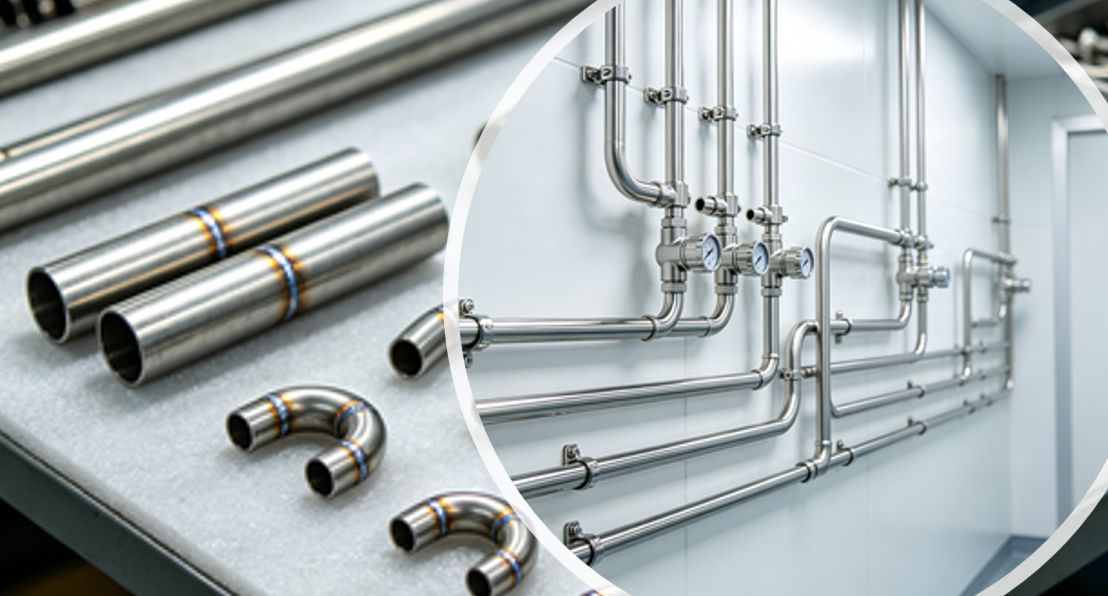
In a piping system, straight pipes are responsible for "moving," while fittings handle "turning, branching, merging, and changing diameter." Titanium alloy fittings are the key components that "guide" corrosive media, high-pressure fluids, and ultra-pure media.
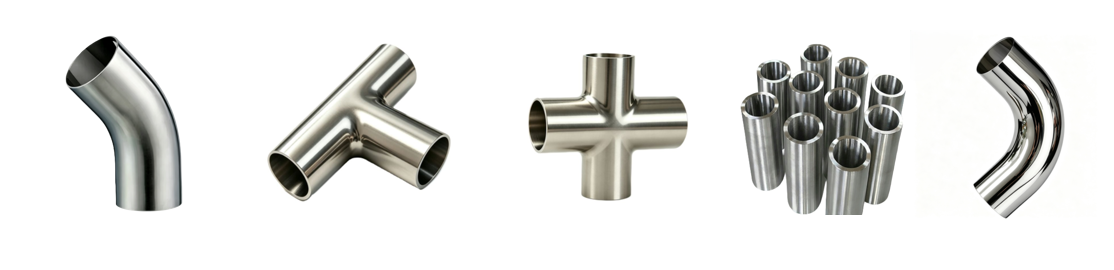
1.90°/45° Elbow: Used for "Turning"
Where is it used?
Almost anywhere that requires a change in flow direction: corrosive media pipelines in chemical plants, seawater piping on ships, hydraulic lines in aircraft.
Why titanium?
At elbows, the change in flow velocity can easily create turbulence and erosion-corrosion. For stainless steel elbows in seawater or acidic media, erosion-corrosion rates are 3–5 times faster than in straight pipes. Titanium's resistance to erosion-corrosion is far superior to that of copper-nickel alloys and stainless steel.
Selection tips:
-Long-radius elbow (R=1.5D): Mainstream choice, low pressure drop, suitable for most conditions.
-Short-radius elbow (R=1.0D): Used when space is limited, but higher pressure drop and more severe erosion.
-Wall thickness should be one schedule higher than the straight pipe (e.g., Sch40S → Sch80S) to compensate for stress concentration at the bend.
Typical product: TA2 commercially pure titanium 90° long-radius elbow, DN50, Sch40S, for seawater cooling systems.
2.Straight Tee: Used for "Branching"
Where is it used?
Where a branch line is needed from the main pipe, such as fire protection ring mains, distribution headers, and inlet/outlet manifolds of heat exchangers.
Why titanium?
Tees have distinct vortex zones and stress concentration areas, where ordinary metals are prone to erosion and fatigue cracking. Titanium's erosion resistance and fatigue strength make it the first choice for high-reliability applications. In seawater, acetic acid, wet chlorine gas, etc., titanium tee service life is 5–10 times that of stainless steel.
Selection tips:
-Forged tee: One-piece formed, no welds, high strength, suitable for high pressure (≥4.0MPa).
-Welded tee: Branch pipe welded to main pipe, lower cost but requires weld inspection.
-Pay attention to tee crotch wall thickness: Often thicker than the main pipe wall. Standard parts comply with GB/T12459 or ASME B16.9.
Typical product: Ti-6Al-4V straight tee, DN80×80, for aircraft engine fuel distribution lines.
3.Reducing Tee: Used for "Branching + Reducing"
Where is it used?
When the main pipe is larger than the branch pipe, requiring simultaneous flow division and diameter reduction. For example, from a DN100 main line to a DN50 branch line going to an instrument or small piece of equipment.
Why titanium?
Reducing tees have greater geometric abruptness and a higher stress concentration factor than straight tees. Titanium's high yield strength allows it to withstand this stress without plastic deformation. In highly corrosive environments (e.g., hot seawater, sodium hypochlorite), reducing tees are often made from solid forged titanium to avoid weld corrosion.
Selection tips:
-The branch diameter of a reducing tee is typically 1/2 to 3/4 of the main pipe diameter. For smaller branches, use a reducer + tee combination.
-Prefer seamless forged parts (socket weld or butt weld) over welded tees with a hole cut later, as the latter have poor stress distribution.
Typical product: TA9 (titanium-palladium alloy) reducing tee, DN100×50, for staged water intake in seawater desalination plants.
4.Cross: Used for "Cross Flow Division"
Where is it used?
When flow needs to be split simultaneously in two perpendicular directions, or when four lines meet. Most common in fire protection sprinkler system cross piping and chemical plant annular distribution lines.
Why titanium?
Crosses have a complex stress state; thermal expansion of the four connected pipes mutually constrains each other. Titanium's coefficient of thermal expansion is about half that of steel. In applications with large temperature fluctuations, thermal stresses are much lower than with steel, making titanium suitable for lines with significant temperature changes.
Selection tips:
-Crosses are typically cast or forged + machined, rarely welded (too many welds, high residual stress).
-Commercially pure titanium (TA2) is suitable for normal and medium-low temperatures; for high temperatures, choose Ti-6Al-4V.
-Because crosses are difficult to manufacture, stock is limited and they often require custom ordering.
Typical product: TA2 cross, DN65, for the main foam extinguishing system piping on offshore platforms.
5.Reducer (Concentric/Eccentric): Used for "Changing Diameter"
Where is it used?
Where two straight pipes of different diameters connect. For example, at pump outlets (diameter increase), around flow meters (diameter change), or when equipment nozzles don't match pipe size.
Why titanium?
Reducers experience the greatest change in flow velocity. A sudden reduction from DN100 to DN50 can increase velocity by a factor of four, dramatically raising erosion-corrosion. Titanium's passive film can quickly self-repair in high-velocity fluids, whereas the passive film on 316L stainless steel, once eroded, leads to rapidly accelerating corrosion.
Selection tips:
-Concentric reducer: Pipe centerlines align, used for vertical pipes or pump suction/discharge.
-Eccentric reducer: Flat on bottom or top, used for horizontal pipes to avoid liquid pooling.
-Wall thickness transition should be gradual; typically use long-neck reducers (taper length ≥ large end diameter).
Typical product: TA10 (titanium-molybdenum-nickel alloy) eccentric reducer, DN150×80, for high-temperature wastewater lines containing chloride ions.
6.Cap / Plug: Used for "Sealing Off"
Where is it used?
Pipe ends, test ports, spare connections, blowdown points.
Why titanium?
Caps are the final closure of a pipe and must withstand full system pressure. Titanium caps are 40% lighter than stainless steel and never rust. For blind ends that require frequent disassembly (e.g., blowdown ports), titanium threaded plugs have better galling resistance than stainless steel.
Selection tips:
-Weld cap: Permanent sealing, highest pressure rating.
-Threaded plug: Removable, suitable for connections needing maintenance, but note titanium-on-titanium thread galling; anti-seize compound is recommended.
Typical product: Ti-6Al-4V threaded pipe cap, 3/4″ NPT, for aerospace hydraulic system test ports.
Selection Summary
Recommendations for titanium alloy fittings under different operating conditions:
-Seawater cooling line turns: Choose 90° long-radius elbow, TA2 commercially pure titanium, erosion-corrosion resistant.
-Chemical distribution header branching: Choose straight or reducing tee, preferably TA9 (titanium-palladium) for crevice corrosion resistance.
-Fire protection ring main cross branching: Choose cross, TA2, low thermal stress and lightweight.
-Pump inlet/outlet diameter change: Choose eccentric reducer, TA10 (titanium-molybdenum-nickel), resistant to high-velocity fluid erosion.
-High-temperature, high-pressure fuel lines: Choose butt-weld elbow or tee, Ti-6Al-4V, high strength and heat resistance.
-Removable closure: Choose threaded cap, Ti-6Al-4V with anti-seize coating, lightweight and reusable.
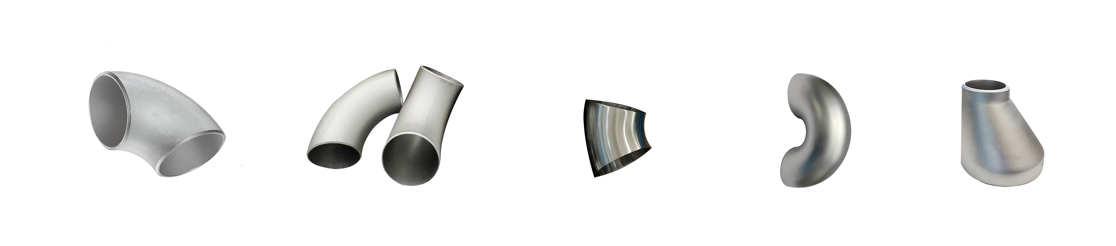
7.Three Final Practical Suggestions
Same material principle: Fitting material should be the same as or higher grade than the pipe (e.g., pipe uses TA2, fitting uses TA9). Avoid titanium pipe with stainless steel fittings — galvanic corrosion will quickly perforate the stainless steel.
Wall thickness "go high": The back (outer arc) and crotch wall thickness of elbows and tees will be reduced during forming. When purchasing, specify "wall thickness not less than nominal wall thickness of straight pipe," or simply buy Sch80S grade.
Thicker is not always better: Excessive thickness increases welding heat input, which can actually reduce corrosion resistance of the joint. Choosing standard wall thickness schedules is the safest approach.

Hello, I am the online customer service
