


The manufacturing process of titanium tees
View More
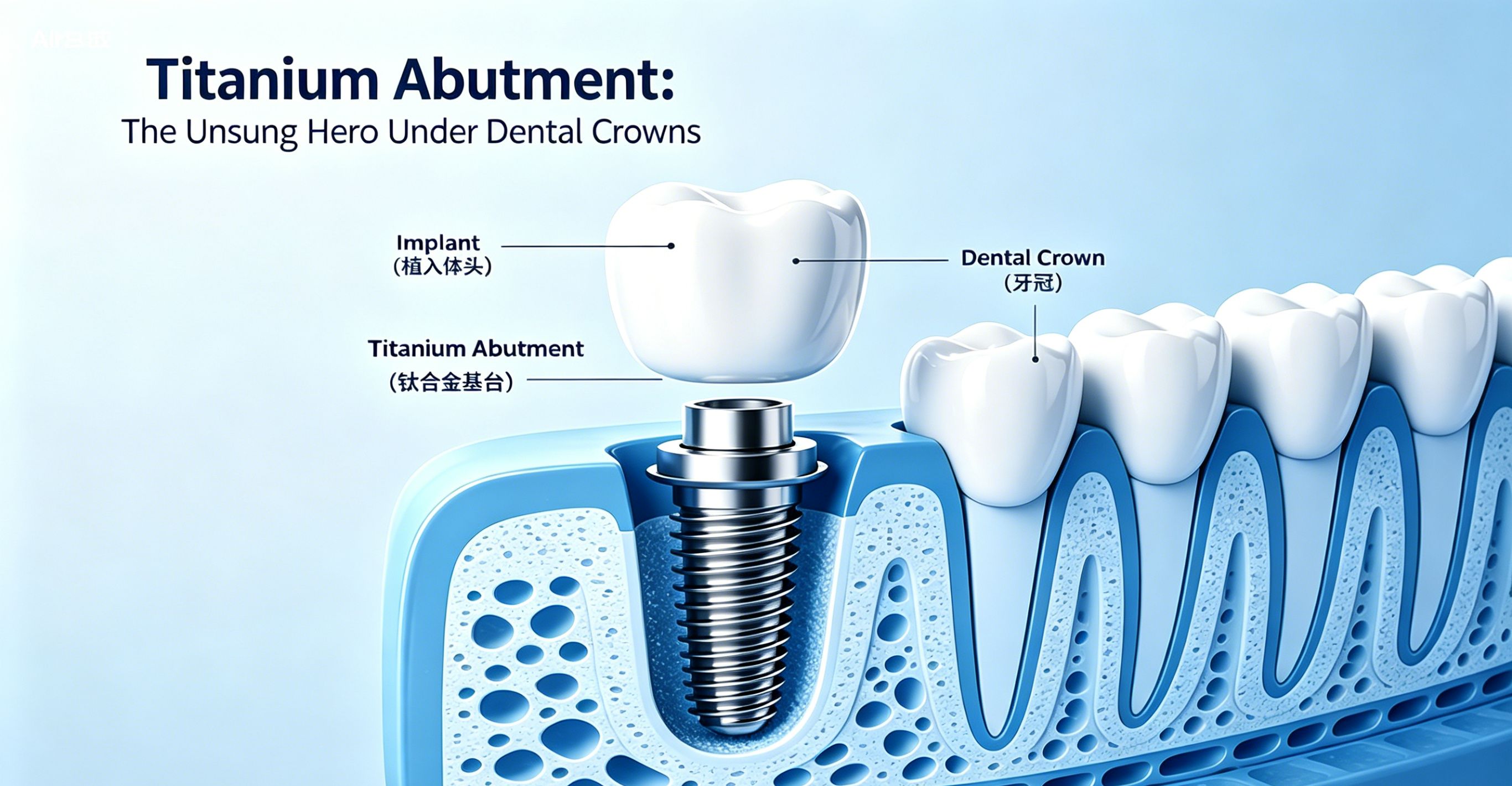
If you know something about dental implants, you’ve probably heard of the implant fixture (the "artificial root" screwed into the bone) and the crown (the visible "fake tooth" used for chewing). But few notice the connecting piece between them — the abutment, often referred to in prosthodontics as the "support" or "connector."
An abutment looks like a precision metal adapter: it connects to the implant below, supports the crown above, and is held together by a central screw. It has three tasks: transmitting bite forces, sealing the interface, and shaping the emergence profile for aesthetics.
In short: without an abutment, the implant and crown are just two unrelated parts.
I.Why is Titanium Alloy the First Choice for Abutments?
Historically, abutments have been made of gold, stainless steel, or even zirconia. But today, titanium alloy (especially Ti-6Al-4V ELI) has become the mainstream choice for most posterior restorations. Three reasons:
1.High strength, not brittle
Abutment walls are often less than 1 mm thick and must withstand bite forces of hundreds of newtons. Zirconia abutments, though aesthetic, carry a risk of brittleness — they may fracture under thin walls or complex loading. Titanium alloy has a fracture toughness 3–5 times that of zirconia; it may deform but won’t shatter suddenly.
2.Same material as the implant – avoids galvanic corrosion
Most implants themselves are titanium alloy. If the abutment were made of a different metal (e.g., cobalt-chromium), the difference in electrical potential in the moist oral environment would cause galvanic corrosion — accelerating corrosion of the more active metal. Titanium-on-titanium is the safest "marriage."
3.Good sealing capability
There is a tiny interface gap between the abutment and implant. Titanium alloy can be machined to micron-level precision, and with controlled torque, it effectively reduces bacterial leakage — a key factor in preventing peri‑implantitis.
II. Two Main Manufacturing Processes for Titanium Abutments
Currently, titanium abutments are produced mainly by two methods: CNC machining and 3D printing. Each has its pros and cons.
Machined Abutments – King of Precision
-Process: Directly turned/milled from titanium bar (TA4 or Ti-6Al-4V ELI).
-Advantages: Extremely high surface finish (Ra < 0.4 μm); fit accuracy down to ±5 μm; almost no post-processing needed.
-Disadvantages: Low material utilization (up to 70% of the titanium becomes chips); difficult to fabricate complex shapes (e.g., custom emergence profiles).
-Applications: Standard stock abutments, screw‑retained restorations requiring ultra‑high fit accuracy.
-Typical data: A 4.8 mm diameter machined titanium abutment has a fracture torque >45 N·cm and can withstand 5 million cycles in fatigue testing.
3D Printed Abutments – King of Customization
-Process: Selective laser melting (SLM) or electron beam melting (EBM) using Ti-6Al-4V powder.
-Advantages: Can produce any complex emergence profile or concave aesthetic design; material utilization >90%; lower per‑unit cost for batch production than machining.
-Disadvantages: Rough surface (Ra ~5–10 μm) requiring sandblasting or polishing; possible micro‑pores; fatigue strength slightly lower than forged/machined equivalents.
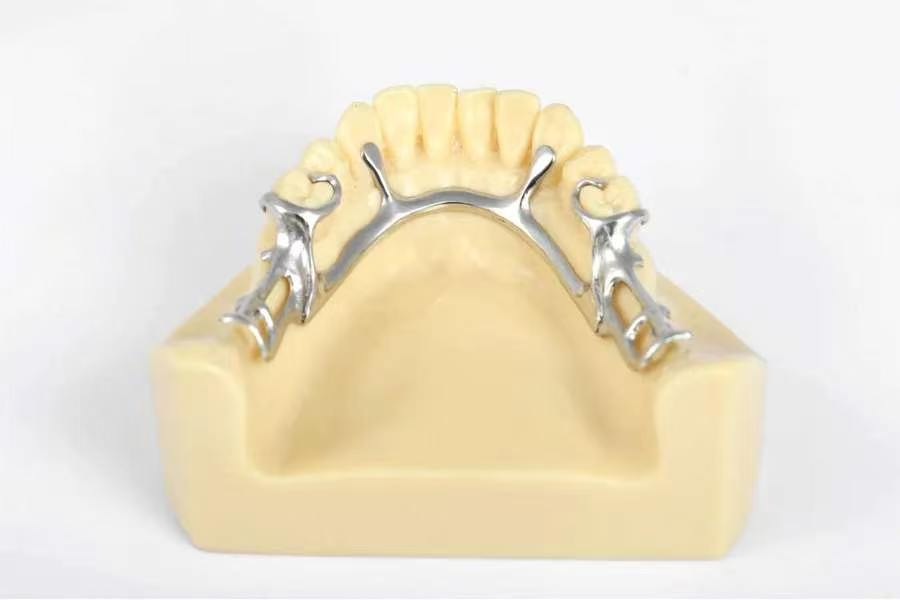
-Applications: Custom aesthetic restorations, multi‑implant bars, full‑arch implant frameworks.
-Practical example: A titanium bar for a full‑arch overdenture can be 3D printed in one piece, accurately matching 4–6 implant positions within 0.1 mm error.
III. Three Key Parameters for Abutment Selection
If you are selecting a titanium abutment for a patient or a lab, focus on these three points:
1.Connection interface – internal hex, hexagon, or taper lock?
The shape of the implant’s top interface determines the matching abutment base. The most common types:
-Internal hex (e.g., Straumann, Nobel Biocare): good anti‑rotation, widely used.
-Taper lock (Morse taper): friction‑fit locking, extremely low screw loosening rate, but requires high machining precision.
-External hex: used in older systems, now declining.
Key rule: The abutment interface must strictly match the implant system – brands are not interchangeable.
2.Height and emergence height
A critical dimension: from the implant platform to the crown margin, also called emergence height (typically 1–5 mm). If the gingiva is thick, a taller emergence abutment is needed; otherwise the crown will compress the gingiva causing inflammation. Stock abutments usually offer 2 mm, 3 mm, and 4 mm heights; custom abutments can be freely designed.
3.Screw channel and material strength
The abutment is fixed to the implant by a central screw. If the screw channel angle exceeds 25°, an angled screw channel abutment is required, otherwise the driver cannot tighten it properly. Titanium alloy has an advantage over zirconia here – zirconia cannot tolerate large‑angle screw channels (prone to cracking), while titanium can safely handle 30°–45°.
Practical data: A 30° angled titanium abutment still has a fatigue strength >300 N, sufficient for posterior use.
IV. Common Types of Titanium Abutment Products on the Market
-Stock prefabricated abutments: Fixed height and diameter, for standard cases. Brands include Straumann Syncro, Nobel Active, Dentsply Ankylos, etc. Lower cost, fast delivery.
-CAD/CAM custom abutments: Designed by the clinician or technician, milled or printed digitally. They can precisely match the gingival sulcus shape, offering far better aesthetics than stock. Preferred for anterior aesthetic zones.
-Temporary abutments: Made of plastic or titanium; used for healing phase temporary restorations. Titanium temporary abutments are stronger than plastic and can be sterilized and reused.
-Implant bars (bar attachments): Used for overdentures supported by multiple implants. A titanium bar connects several implants, and a removable denture clips onto it. Commonly made from wrought titanium or 3D printed titanium.
V.Clinical Pitfalls – Easy Mistakes to Avoid
1.Do not mix abutments and implants from different brands – even if the threads look similar, the internal taper or hex may differ. Forcing them can cause micro‑movement or fracture.
2.Tighten the central screw to the specified torque – titanium screws typically require 30–35 N·cm. Over‑tightening deforms the threads, under‑tightening causes loosening.
3.Do not apply lubricants or glue between abutment and implant. Clean and dry the surfaces, then tighten. If anti‑loosening is needed, use a factory‑specified pre‑torqued screw.
4.In aesthetic zones, titanium color may show through thin gingiva – if the patient has thin gingiva (<2 mm), consider a zirconia abutment, or use an anodized gold/pink titanium abutment to reduce the metallic hue.
VI. Conclusion
The titanium alloy abutment – just a few millimeters in size, weighing a few grams – plays a vital “load‑bearing and connecting” role in implant restorations. It doesn’t have the story of an implant being embraced by bone, nor the direct aesthetic appeal of a crown. Yet its precision, strength, and biocompatibility determine the long‑term success of the entire prosthesis.
If you ever need a dental implant, consider asking your dentist: “What material is my abutment? Titanium or zirconia? Machined or printed?” – that question alone will show you’re no layperson.
Because a reliable abutment is the real foundation for a crown that “lasts ten years without falling out.”

Hello, I am the online customer service
