


The manufacturing process of titanium tees
View More
In chemical production, seawater desalination, flue gas desulfurization and other industrial scenarios, pipelines are continuously exposed to salt water, corrosive gas and acid liquid. They also bear long-term fluid scouring and temperature changes, making them the most frequently damaged and replaced components in industrial equipment. In the past, factories mostly used carbon steel and stainless steel bend pipes due to their low purchase cost. However, in complex corrosive working conditions, these pipes easily suffer from rust, perforation and cracking, which affect continuous production and cause high costs of maintenance, replacement and production shutdown. As industrial production becomes more refined, material selection no longer only focuses on low initial cost, but emphasizes long-term stability and comprehensive economic benefits.
As a high-performance special pipe material, titanium bend pipes effectively solve the defects of traditional pipes and have been widely used in high end chemical and marine engineering, forming a new trend in industrial material selection.
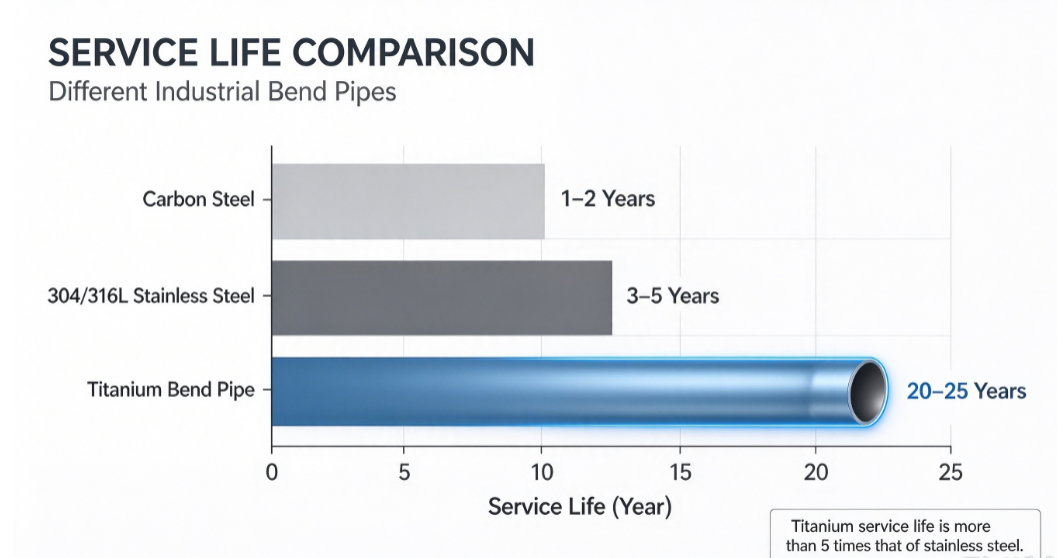
Carbon steel and stainless steel bend pipes are widely used in general industrial fields and are suitable for non-corrosive environments. Nevertheless, they show obvious performance shortcomings in harsh and high-end working conditions.Carbon steel pipes have poor corrosion resistance. They rust rapidly when contacting seawater, salt water and acid media, resulting in wall thinning and leakage in a short time. Frequent maintenance and replacement are required. Therefore, carbon steel pipes are only applicable to ordinary clean water environments and cannot meet the requirements of chemical and marine engineering projects. Although 304 and 316L stainless steel pipes are more corrosion-resistant than carbon steel, they are still susceptible to pitting corrosion, crevice corrosion and stress cracking in chloride-rich seawater and brine. Their normal service life is only 3 to 5 years. Frequent pipeline replacement leads to production shutdown, material waste and increased labor costs, resulting in high comprehensive operating costs in the long run.
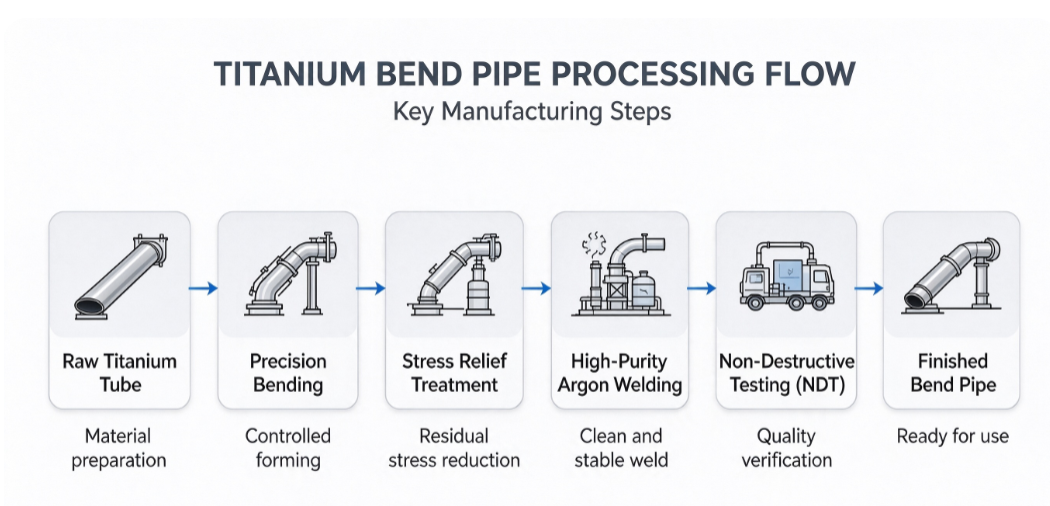
Made of industrial pure titanium and processed through precision bending, heat treatment and professional welding, titanium bend pipes feature stable performance and outstanding comprehensive advantages, which can adapt to various complex and harsh industrial environments.
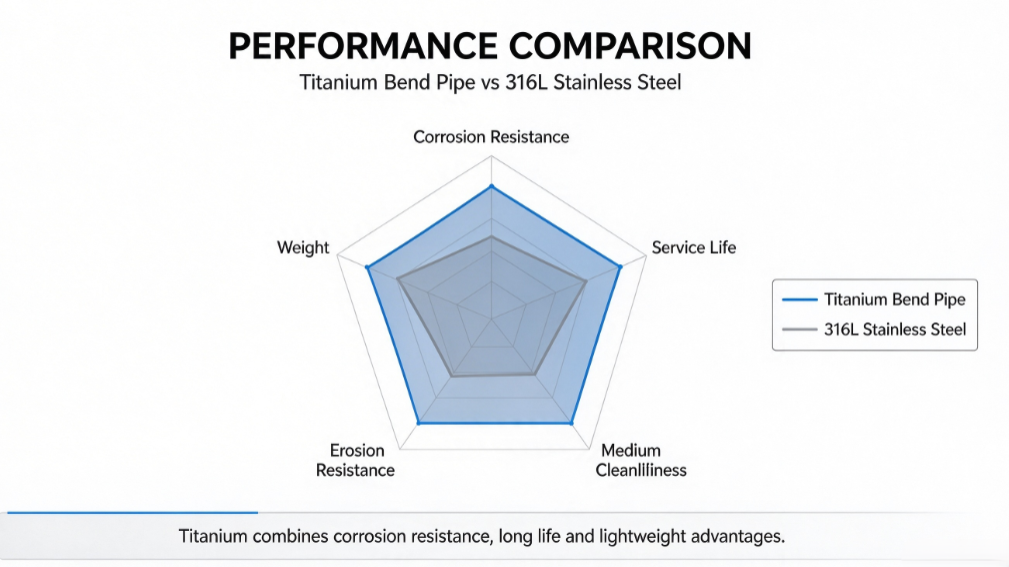
The most prominent advantage of titanium materials is excellent corrosion resistance. A dense and self-repairing titanium dioxide passive film will form automatically on the titanium surface, isolating the substrate from corrosive media. In seawater, salt water, wet chlorine, weak acid and other common chemical media, titanium bend pipes are barely corroded and free from rust, cracking and leakage. Practical application shows that the service life of titanium bend pipes can reach 20 to 25 years, more than 5 times that of stainless steel pipes. It greatly reduces pipeline maintenance and replacement frequency, and effectively lowers production shutdown losses and equipment maintenance costs.
Titanium has a low density, only about 60% of steel, and combines light weight with high strength. Under the same pressure bearing standard, titanium bend pipes are much lighter than carbon steel and stainless steel pipes. They do not require heavy support structures, making hoisting and construction simpler and faster. This shortens the construction cycle and saves engineering and labor costs, which is very suitable for large chemical equipment, offshore platforms and marine pipeline projects.
Titanium has extremely stable chemical properties. The inner wall of titanium bend pipes is smooth and will not precipitate metal impurities during operation. In contrast, stainless steel pipes may release metal ions in acidic and complex environments, contaminating production materials. Therefore, titanium bend pipes are highly suitable for fine chemical industry, pharmaceutical manufacturing, pure water purification and other fields with high requirements for material purity, ensuring stable product quality.
The elbow position of a pipeline bears the most severe fluid scouring and is the weakest part of traditional pipes. The passive film on titanium surfaces features excellent wear resistance, erosion resistance and cavitation resistance. It can withstand long-term fluid impact and tiny particle scouring without local thinning or damage. In addition, titanium bend pipes have good low-temperature toughness and non-magnetic properties, adapting to alternating cold and hot working conditions with wider application scenarios than traditional pipes.
In the early stage, domestic titanium bend pipe manufacturing technology was immature. Products suffered from large residual stress, iron contamination, poor welding quality and low precision. High-end titanium bend pipes mainly relied on imports with high prices and long delivery cycles, limiting market promotion and application. In recent years, domestic titanium processing technology has been greatly improved. Precision bending, stress relief treatment, high-purity argon welding and non-destructive testing technologies have been widely adopted, completely solving the traditional processing defects. Refined production management greatly improves product precision, stability and corrosion resistance. High-end titanium bend pipes have achieved localized mass production, breaking foreign monopoly and reducing procurement costs. At present, titanium bend pipes are widely used in chemical industry, marine engineering, shipbuilding, new energy, nuclear power and other high-end fields with increasing market penetration.
Domestic industry is developing toward high-end and refined upgrading, with increasingly strict standards for environmental protection, safety and operational stability. Traditional pipes are prone to damage, unstable in operation and high in maintenance cost, which can no longer adapt to the upgrading of high-end industry. Current material selection focuses more on long-term durability, low maintenance and high safety rather than low initial price. With the comprehensive advantages of corrosion resistance, light weight, high cleanliness and long service life, titanium bend pipes perfectly meet the development needs of high-end chemical, marine engineering and new energy industries. They will gradually replace carbon steel and stainless steel pipes and become the mainstream choice for high-end industrial pipeline systems. With the continuous improvement of domestic technology and cost optimization, titanium bend pipes will have broader application scenarios and promote the upgrading of domestic high-end equipment manufacturing industry.
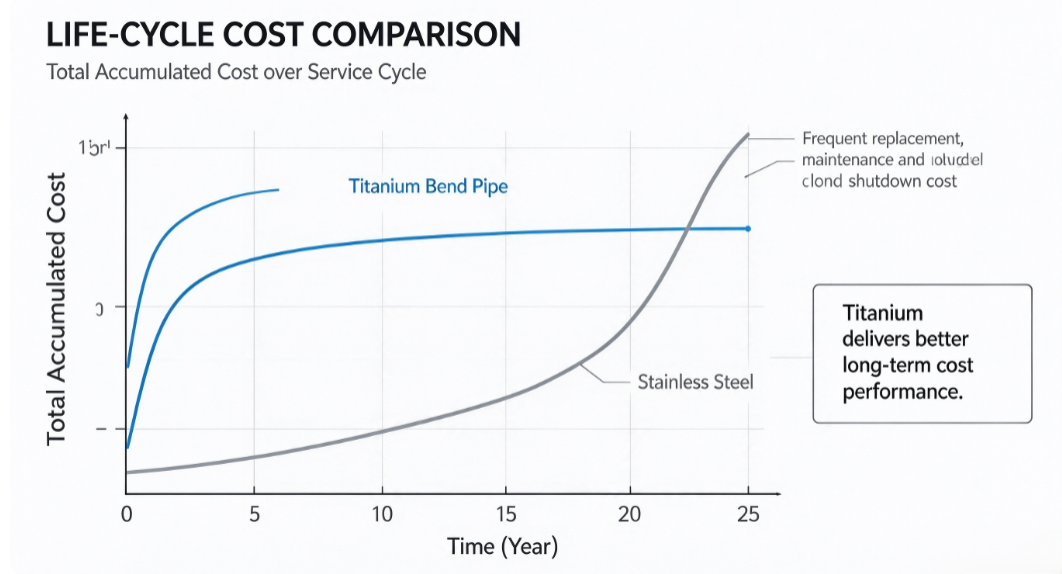
In summary, in highly corrosive and complex working conditions, titanium bend pipes have far better comprehensive performance than carbon steel and stainless steel pipes, solving the core problems of traditional pipes such as easy corrosion, short service life, high maintenance cost and medium pollution. Although titanium bend pipes have higher initial procurement costs, they show higher long-term cost performance due to their ultra-long service life and extremely low maintenance costs. Under the trend of industrial upgrading, domestic titanium bend pipes possess broad market prospects and high application value, and will continuously support the stable development of high-end industries including chemical, marine engineering and new energy

Hello, I am the online customer service
