


The manufacturing process of titanium tees
View More
No need to reference thick material handbooks. The simplest way to select 3D printing titanium is to start from your application: identify the core working requirement of the component first, then match the suitable grade.
Four titanium grades dominate additive manufacturing: TC4, TC4 ELI (Grade 23), CP-Ti TA1/TA2, and TA15. Grade selection hinges on three core properties: strength, fracture toughness and corrosion resistance.


Quick tip: Choose TC4 for high strength-to-weight parts without extreme toughness demands. TC4 is the mainstream workhorse for 3D printed titanium, covering ~90% market share. Tensile strength: 950–1050 MPa, density: 4.41 g/cm³. Typical uses: aircraft brackets, structural frames, non-rotating rocket parts, racing suspension, premium tooling. It balances performance and cost, with oxygen limit up to 0.20%, lower powder cost and wider stable printing window. It is the default for general load-bearing components excluding medical implants. Not suitable for in-body implantation or parts requiring high toughness under cryogenic / high-cycle fatigue.
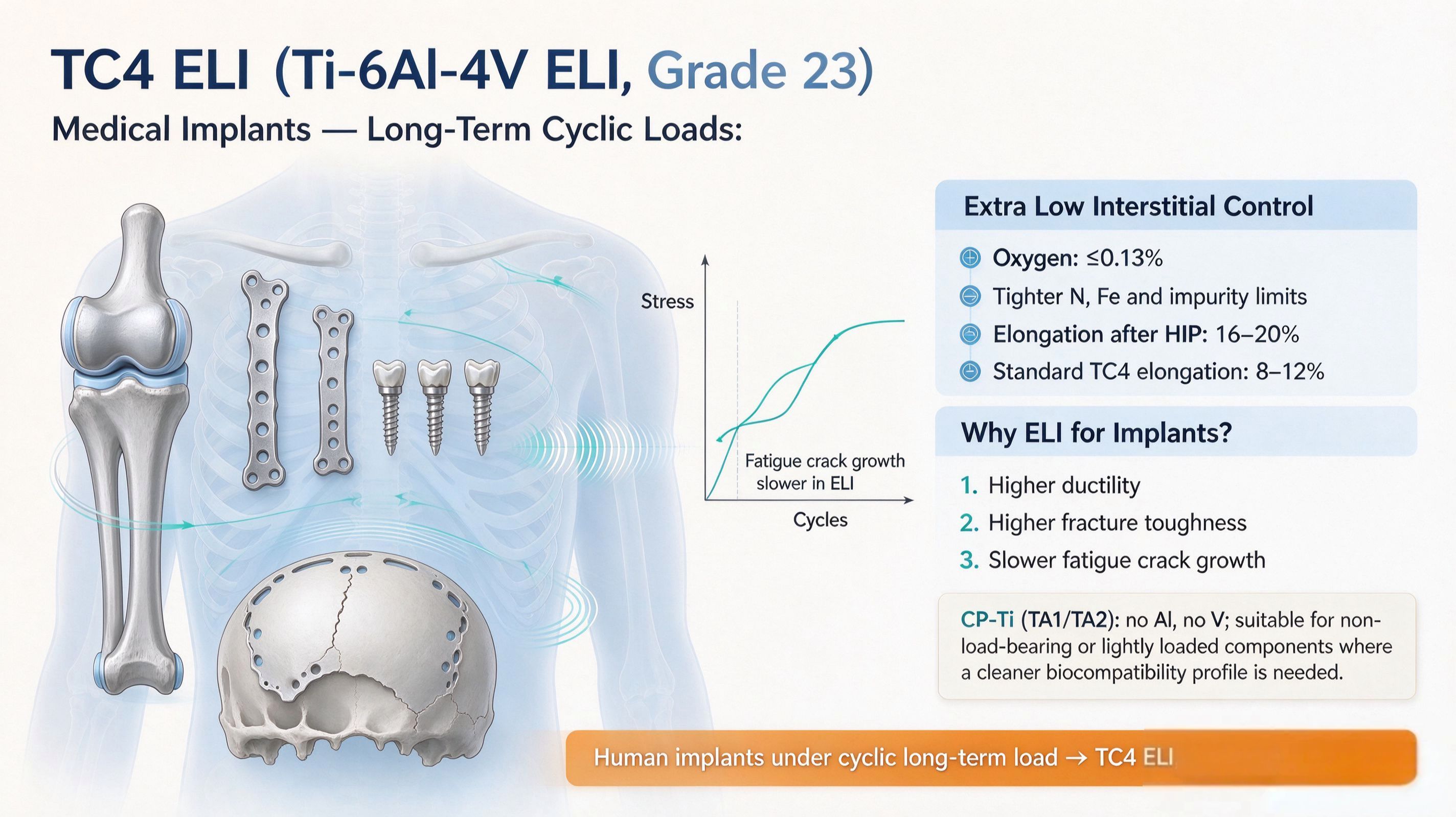
Quick tip: TC4 ELI is mandatory for long-term cyclic-load implants. ELI = Extra Low Interstitial. Same base composition as TC4, but oxygen ≤0.13%, with stricter controls on N, Fe and impurities. It delivers superior ductility, fracture toughness and slower fatigue crack propagation. HIP-treated TC4 ELI reaches 16–20% elongation vs 8–12% for standard TC4. Typical uses: artificial joints, bone plates, dental implants, cranial repair prosthetics. These bear repeated cyclic loads for decades inside human bodies. Note: CP-Ti (TA1/TA2) is also biocompatible, free of Al & V leaching risks, but lower strength, only fit for non-load / lightly loaded implants.

Quick tip: Pick CP titanium when corrosion resistance outweighs strength requirements. CP titanium forms a stable, long-lasting TiO₂ passive film, outperforming TC4 in harsh corrosive media, seawater, wet chlorine and chloride solutions. Typical uses: corrosion-resistant valves, heat exchanger tube sheets, seawater manifolds, sensor housings. Grade 2 CP-Ti: yield 340–410 MPa, tensile 420–480 MPa. Ideal for heavy-corrosion, low-load parts. Select TC4 only when both corrosion resistance and high load capacity are required.
TA15 sits above TC4 in high-temperature strength and weldability. It targets aero-engine medium-temperature load-bearing components. Select TA15 if TC4 cannot meet your requirement, while ultra-high-strength alloys (Ti-1023, Ti5553) are excessive for your project.
-Aerospace structure / racing parts / high-end tooling → TC4
-Load-bearing medical implants → TC4 ELI (Grade 23, oxygen ≤0.13%)
-Chemical & seawater corrosion service → CP-Ti TA1/TA2
-Electronic internal structure (hinge, midframe) → TC4
-Skin-contact electronic accessories → TC4 ELI
-Aero medium-temperature parts (TC4 insufficient, ultra-high strength alloy overkill) → TA15
When requesting quotes from powder suppliers or AM service vendors, provide 4 key details instead of only asking for titanium price per kg: end application, implant / skin contact status, corrosive medium, load type (static / cyclic). Let suppliers recommend grades for your working conditions.
If you hesitate between TC4 and TC4 ELI for your component, share your application and service conditions for tailored grade advice.
If you're ready to request a quote, a sample, or technical guidance on which titanium grade fits your project, reach out directly
Email: sales@globaltigroup.com
The team can walk through your specifications, confirm certifications, and arrange fast delivery for your next order.

Hello, I am the online customer service
