


The manufacturing process of titanium tees
View More
In the actual installation of titanium piping systems, flanged connections are among the most common and reliable methods. However, many users tend to focus on flange material, pressure rating, and size class while overlooking the critical detail of the sealing face type. In fact, different sealing face designs directly affect sealing performance, required installation torque, gasket selection, and long-term leakage risk. This article briefly analyzes several mainstream sealing face types for titanium flanges and their impact on installation outcomes.
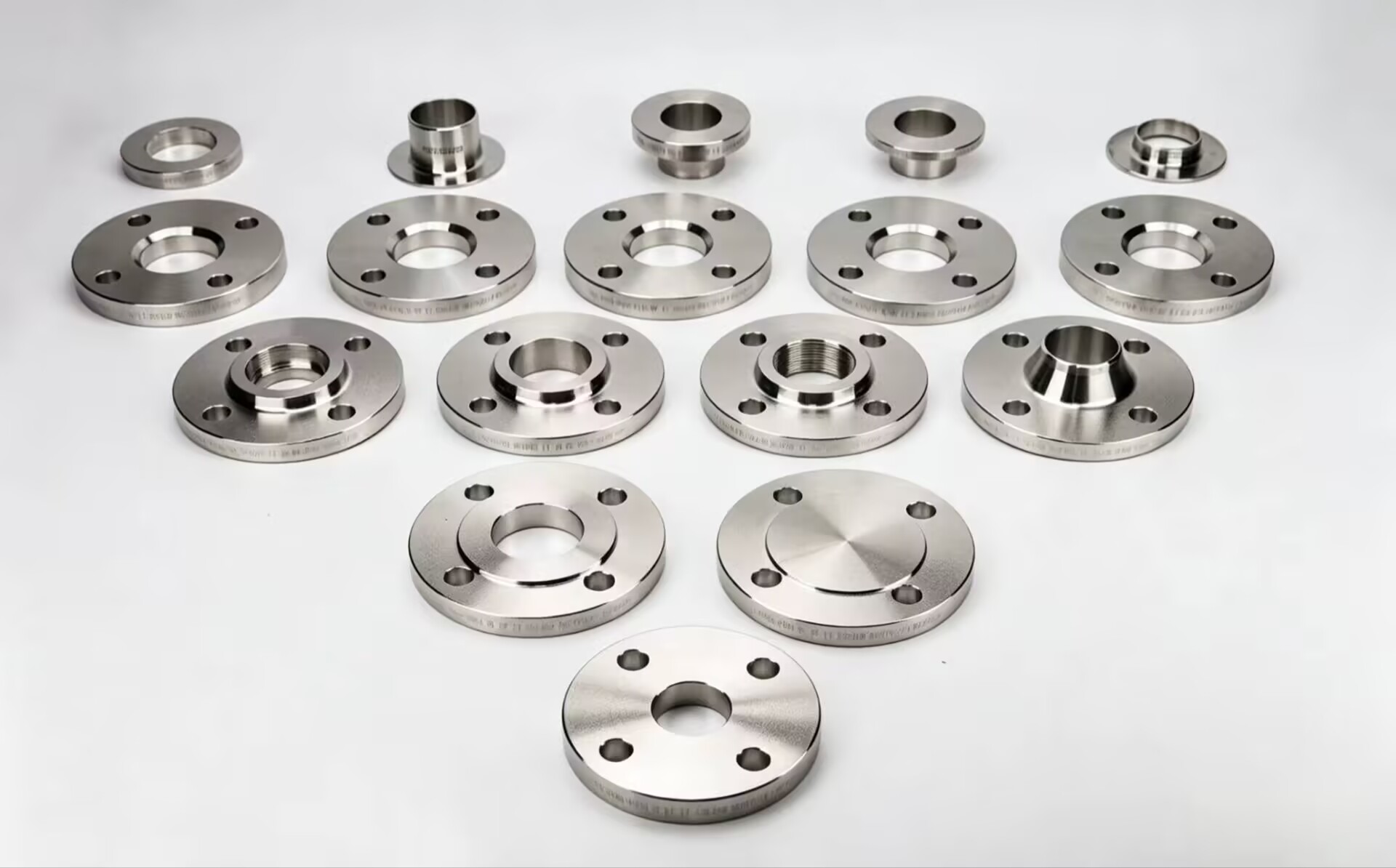
1.Raised Face (RF) – The Most General-Purpose Choice
The raised face flange is the most common sealing face in industrial piping, with a sealing surface slightly raised above the bolt hole plane. For titanium flanges, the RF type is easy to machine, moderately cost-effective, and suitable for most ambient-temperature, low-to-medium pressure applications.
In terms of installation, RF flanges offer the greatest gasket compatibility, working with non-metallic flat gaskets, spiral wound gaskets, and more. However, due to the relatively wide sealing contact area, achieving a good seal often requires high bolt preload. If preload is uneven during installation, the gasket may become misaligned or the flange face may deform locally. Although titanium has high strength, its surface hardness is relatively low; excessive local pressure can scratch the sealing face, affecting reusability.
2.Flat Face (FF) – For Low-Pressure, Large-Diameter Applications
Flat face flanges have a sealing surface that covers the entire flange face, typically used for low-pressure ratings (e.g., PN6, PN10) and large-diameter pipes. FF titanium flanges are common in atmospheric tank nozzles and low-pressure circulating water lines.
From an installation perspective, FF flanges require precise gasket positioning and are prone to gasket shifting. Since the sealing surface covers the entire flange face, bolt preload is spread out; achieving the same sealing effect often requires more bolts or greater flange thickness. Additionally, FF flanges are sensitive to alignment – if pipe alignment is poor and flange faces are not parallel, leakage risk increases significantly.
3.Male & Female Face (MFM) – Accurate Centering, Reliable Sealing
MFM flanges consist of a male flange and a female flange used as a pair, with the male face fitting into the female face to form a self-centering structure. This type is often used in titanium piping for medium-to-high pressure and hazardous media applications.
The main advantage of MFM flanges is automatic alignment during installation, effectively preventing gasket extrusion from the sealing face. The narrower sealing width means the same bolt preload produces higher sealing contact pressure, resulting in better sealing than RF flanges. However, this imposes higher installation requirements: the clearance between male and female faces must be within a reasonable range, otherwise a false tightness condition (male face bottoming out without female face contact) may occur. Also, machining MFM faces on titanium flanges is more difficult and costly than RF faces.
4.Tongue & Groove Face (TG) – Preferred for Severe Conditions
Tongue and groove flanges consist of a tongue flange and a groove flange used as a pair, with the gasket placed inside the groove. In titanium piping, this type is mainly used for high-temperature, high-pressure, or flammable/explosive/toxic media applications.
TG flanges provide very stable installation performance: the gasket is fully confined within the groove, preventing displacement even under vibration or temperature fluctuations. The very narrow sealing width converts almost all bolt preload into sealing pressure, resulting in extremely low leakage rates. However, TG flanges demand the highest installation precision; any slight mismatch in the tongue-groove clearance can cause local over-tightening or looseness. Additionally, gasket cleaning is difficult during disassembly, and the tongue’s sharp edges are prone to wear or fretting damage with repeated assembly/disassembly of titanium flanges.
5.Ring Joint Face (RTJ) – For Extreme High-Pressure Conditions
Ring joint flanges use a metal ring gasket seated in a trapezoidal groove on the flange face, forming a metal-to-metal hard seal. RTJ titanium flanges are primarily used in ultra-high-pressure or high-temperature cyclic conditions, such as subsea oil production equipment and high-pressure reactors.
RTJ flange installation requires extremely strict bolt preload control: insufficient preload fails to compress the ring gasket; excessive preload may deform or even crack the titanium flange’s trapezoidal groove. The ring gasket material must be compatible with the titanium flange to avoid galvanic corrosion. In practice, RTJ flanges are typically tightened stepwise, symmetrically, using a torque wrench, with final elongation recorded. If leakage occurs after installation, simple re-tightening is usually insufficient; disassembly is often required to inspect the ring gasket or groove face for damage.
In practical engineering, the choice of sealing face type for titanium flanges should not be based solely on cost or habit, but on comprehensive consideration of media characteristics, pressure-temperature rating, installation conditions, and maintenance needs. For most conventional titanium piping systems, RF flanges offer the best cost-performance ratio. For hazardous or leak-critical applications, MFM or TG is more suitable. Under extreme high-pressure conditions, RTJ is nearly the only reliable option.
Proper sealing face selection combined with standardized installation practices is essential to fully realize the advantages of titanium flanges – corrosion resistance, light weight, and high strength – ensuring long-term safe and stable operation of the piping system.

Hello, I am the online customer service
