When you decide to adopt titanium—the "metal of the future",the first decision point is often not which specific alloy grade (e.g., GR1, GR5) to choose, but rather: which form factor should you go with? Flat plate, solid cylindrical bar, or hollow tube? These three options are far more than just shape differences. They correspond to entirely distinct processing routes, mechanical properties, application logics, and cost structures. Choose correctly, and you achieve cost efficiency and enhanced performance. Choose incorrectly, and you may face processing difficulties, skyrocketing costs, or even safety risks for the entire engineering project.
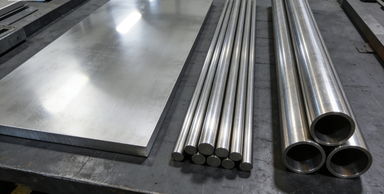
1.Titanium Plate: Large-Area “Surface” and “Shield”
Titanium plate is a flat rolled product made by hot or cold rolling, with a wide thickness range from ultra-thin foil (0.1 mm) to heavy plate (100+ mm). It serves not only as a visual “surface” material but also as a corrosion-resistant “shield.”
Key characteristics:
- Area advantage: Provides large, flat surfaces suitable for broad coverage and cladding.
- Forming flexibility: Thin plates can be stamped, bent, and complex-shaped; thick plates can be cut and welded.
- Surface variety: Can be polished, blasted, pickled, anodized, etc., for different aesthetics.
Typical applications:
- Chemical & environmental: Reactor linings, heat exchanger plates, tower internals – extreme acid/alkali corrosion protection. Recommended thickness: 1.0–3.0 mm.
- Marine engineering: Hulls, desalination components – resistant to chloride attack. Recommended thickness: 2.0–6.0 mm.
- Architectural decoration: Curtain walls, roofing, high-end hotel wall panels – lightweight and durable. Recommended thickness: 0.3–1.5 mm.
- High-tech: Consumer electronics (e.g., phone frames, watch back covers), medical implant blanks. Recommended thickness: 0.4–4.0 mm.
Selection decision points:
- Need a large-area corrosion-resistant covering? → Titanium plate is the first choice.
- Need stamping or bending? → Choose annealed thin plate.
- Relying on welded assembly? → Strictly control flatness and dimensional tolerances.
2.Titanium Bar: Load-Bearing “Skeleton” and “Spine”
Titanium bar is a solid cylindrical product, usually made by forging or extrusion, with diameters from a few millimeters to several hundred millimeters. Among all forms, titanium bar offers the most outstanding structural strength and rigidity.
Key characteristics:
- Absolute strength: Solid cross-section provides excellent tensile, compressive, and torsional performance.
- Precision machining: Ideal for shafts, rods, screws, and other rotationally symmetric parts.
- High stability: Maintains dimensional stability under extreme conditions, resistant to deformation.
Typical applications:
- Aerospace: Engine blades, landing gear components, high-end fasteners. Diameter range: 10–150 mm.
- Medical: Artificial joints, bone screws, orthopedic implant blanks – requires high biocompatibility. Diameter range: 3–20 mm.
- Industrial equipment: Chemical mixing shafts, high-pressure valve stems, pump shafts – corrosion resistance plus high strength. Diameter range: 6–100 mm.
- Sports equipment: Golf club heads, high-performance bicycle frame tubes. Diameter range: 15–50 mm.
Selection decision points:
- Core structure under heavy loads? → Prioritize titanium bar.
- Making precision screws or shafts? → Choose high-accuracy ground or peeled bar.
- Need welded connections? → Pay attention to end beveling and cleanliness.
3.Titanium Tube: Fluid-Carrying “Vessel” and “Passageway”
Titanium tube is a hollow cylindrical product, available as seamless or welded, with outer diameters from a few millimeters to hundreds of millimeters. It is the core solution for efficient fluid transport and heat exchange.
Key characteristics:
- Lightweight transport: Hollow structure reduces weight while maintaining strength.
- Low flow resistance: Smooth inner and outer surfaces give high delivery efficiency.
- Extreme corrosion resistance: Unmatched performance in seawater, strong acids, alkalis, and other aggressive media.
Typical applications:
- Heat exchange systems: Shell-and-tube heat exchangers, condenser tubes – thin walls enable efficient heat transfer. Specifications: OD 12–25 mm, wall 0.5–2 mm.
- Marine & shipbuilding: Seawater piping, shipboard systems – solves long-term corrosion issues. OD 20–200 mm.
- Precision electronics: Earphone casings, high-end e-cigarette tubes – aesthetics plus function. OD 6–15 mm, wall 0.3–0.8 mm.
- Medical micro-devices: Endoscope sheaths, injection needles – thin wall and biocompatibility. OD 0.5–5 mm.
Selection points:
- Transporting corrosive fluids or gases? → Must choose titanium tube.
- Pursuing heat exchange efficiency? → Select thin-wall seamless tube.
- Need bending for installation? → Choose annealed tube and pay attention to stress relief after bending.
4.Practical Case Study: The Wisdom of Combining Forms
In real industrial scenarios, single-form titanium applications are rare; combinations are more common.
Case 1: Seawater Cooling System
- Requirement: Seawater corrosion resistance, high heat exchange efficiency, >20 years of stable operation.
- Solution: Titanium tube (GR2, Φ19×0.9 mm seamless) as tube bundle + titanium plate (GR2) as equipment shell.
- Why: Tube provides highest heat exchange efficiency; plate offers robust protection and mounting base.
Case 2: High-End Medical Implants
- Requirement: High strength, light weight, biocompatibility, precision porous structure.
- Solution: Titanium bar (GR23 medical grade) for core bone screw/plate + 3D-printed titanium powder on surface (porous structure).
- Why: Solid bar ensures initial implant strength and stability; porous surface allows bone ingrowth and fusion.
5.Pitfall Guide: Three Major Misconceptions
- Misconception: Titanium bar is “more advanced” than titanium plate.
Truth: No form is inherently superior – only fit for purpose. Need load → bar. Need coverage → plate. Need conveying → tube.
- Misconception: Titanium tube is always lighter than bar.
Truth: For the same outer diameter, tube is indeed lighter – but only if a hollow structure works. If solid strength is required, tube cannot replace bar.
- Misconception: Same grade means forms are freely interchangeable.
Truth: Processing changes properties. Rolled plate has different grain structure and mechanical properties than forged bar. Always check technical data before changing forms.
6.The Essence of Selection: Precise Matching of Needs and Characteristics
- Need to cover, line, or surface a large area? → Titanium plate
- Need to support, transmit torque, or bear load? → Titanium bar
- Need fluid flow, heat exchange, or lightweight structure? → Titanium tube
In real projects, first clarify the core functional requirement (corrosion resistance, load bearing, or heat exchange?), then consider cost and processing feasibility, and finally decide on the specific form and grade. If you have a specific project or a selection challenge, feel free to provide detailed parameters – our team will offer an in-depth, customized solution analysis.