


The manufacturing process of titanium tees
View More
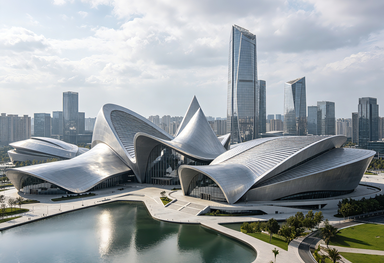
If you walk down Chang'an Avenue in Beijing, you'll undoubtedly be drawn to the silver-gray "giant eggshell" on the west side — the National Centre for the Performing Arts. On sunny days, it glows with a soft luster; on overcast days, it deepens in color; at dusk, it's bathed in warm golden light. This "eggshell" is composed of over 18,000 titanium panels, covering more than 30,000 square meters, making it the world's largest titanium-clad building. Among those 18,000 panels, only four are exactly identical in shape.
Why titanium? Architect Paul Andreu's idea was simple: he wanted a "shell floating on the lake" — light, smooth, capable of reflecting the sky's light, and unchanging for a hundred years. Aluminum wasn't luxurious enough; copper would turn green; stainless steel was too heavy. In the end, he chose a material that had virtually no precedent in Chinese architecture at the time: titanium.
What Makes Titanium Great for Building Skins?
Titanium's advantages as a building material can be summed up in four words: light, strong, inert, and beautiful.
Light. Titanium's density is only 60% that of steel. The titanium panels used on the National Centre for the Performing Arts are only 0.4 mm thick — thinner than a coin. If you used steel panels of the same area, they'd weigh more than twice as much, and the shell structure simply couldn't support it.
Strong. Don't be put off by the 0.4 mm thickness. Titanium's specific strength (strength-to-density ratio) ranks among the top of commonly used metals. Thin, but not brittle.
Inert. Titanium has a self-repairing oxide film on its surface — if it's scratched, it immediately reforms. In industrial atmospheres, marine environments, and acid rain conditions, its annual corrosion rate is virtually zero. The titanium panels on the National Centre for the Performing Arts are officially rated to remain unchanged in color for 100 years. Its corrosion resistance exceeds 50 years.
Beautiful. Titanium has a low reflectivity, presenting a subtle, silvery-gray hue — understated yet textured. Moreover, titanium can be anodized to produce colors like gold, blue, and purple — many buildings in Japan use colored titanium panels for roofs and facades.
Three Buildings That "Wear" Titanium
The Guggenheim Museum Bilbao is the pioneering work of titanium architecture. In 1997, Frank Gehry built a "metal flower"-shaped building on the banks of the Nervión River in Bilbao, Spain. To realize those completely irregular curved surfaces, Gehry used CATIA, a 3D design software originally developed for aircraft manufacturing. The facade uses approximately 33,000 ultra-thin pure titanium sheets, covering 36,000 square meters. Gehry was initially undecided on the material, so he nailed a titanium sample outside his office window and watched how it changed under different lighting conditions day after day — finally, he decided, "This is it." In its first year, the museum contributed nearly 4% of Bilbao's fiscal revenue — a declining industrial city transformed by a titanium building.
Beijing's National Centre for the Performing Arts broke new ground for titanium architecture in China. When construction began in 2004, there was virtually no precedent for architectural titanium use in the country. The ellipsoid shell is made up of over 18,000 titanium panels and more than 1,200 glass panels, each only 0.4 mm thick. To secure these variously shaped panels, engineers used custom fixtures and specially shaped keels — every panel has its unique position; install it wrong and it's useless.
Xi'an's Chang'an Academy took a different path. In 2025, the Northwest Institute for Nonferrous Metal Research introduced titanium to outdoor architecture in Xi'an for the first time, with the "Huating" project on the banks of the Ba River. The main structure uses traditional wooden mortise-and-tenon joinery, while the exterior cladding is made of titanium alloy — a "dialogue between modern materials and traditional craftsmanship."
Beyond these three, there are many other titanium buildings worldwide: Abu Dhabi Airport uses hundreds of tons of titanium; the Denver Art Museum in the U.S. uses 9,000 titanium panels; the LUMA Tower in Arles, France, uses over 11,000 titanium panels; Nippon Steel's TranTixxii titanium brand has been used on some 700 buildings globally. In China, the Hangzhou Grand Theatre, Hefei Grand Theatre, and the Ningbo China Port Museum also feature titanium alloy facades; the roof of the Putuo Mountain Guanyin Holy Temple uses 42 tons of titanium tiles.
Why Aren't Titanium Buildings Everywhere?
If titanium is so great, why isn't it everywhere? The answer boils down to one word: expensive.
Titanium panels cost several times — even over ten times — more than aluminum panels. Moreover, titanium is difficult to process, and welding requires strict protective measures. Architects also lack familiarity with titanium — new materials have arrived, but they haven't yet made their way into designers' "material libraries."
However, the trend is shifting. The life-cycle cost of titanium composite facades (including maintenance and replacement) is already 15% lower than aluminum panels — because titanium requires virtually no maintenance, while aluminum panels need replacing every 20 to 30 years. Titanium-steel composite panel technology can further reduce facade costs by 30% to 50%. Industry forecasts suggest demand for titanium in architectural decoration will exceed 5,000 tons annually in the coming years.
Using titanium for building cladding essentially answers one question: How long does a building want to live? If you only need it to last 30 or 40 years, aluminum panels and coatings will do. But if you want a century-long landmark — something that future generations will still see in its original form — then you need an "inert" material like titanium.
Those 18,000 titanium panels on the National Centre for the Performing Arts — each has its own place. A hundred years from now, when everyone who once walked along Chang'an Avenue is gone, that "giant eggshell" will most likely still be the same color it is today.
That's the philosophy behind titanium's "hat" — giving cities a hat that never fades.

Hello, I am the online customer service
