


The manufacturing process of titanium tees
View More
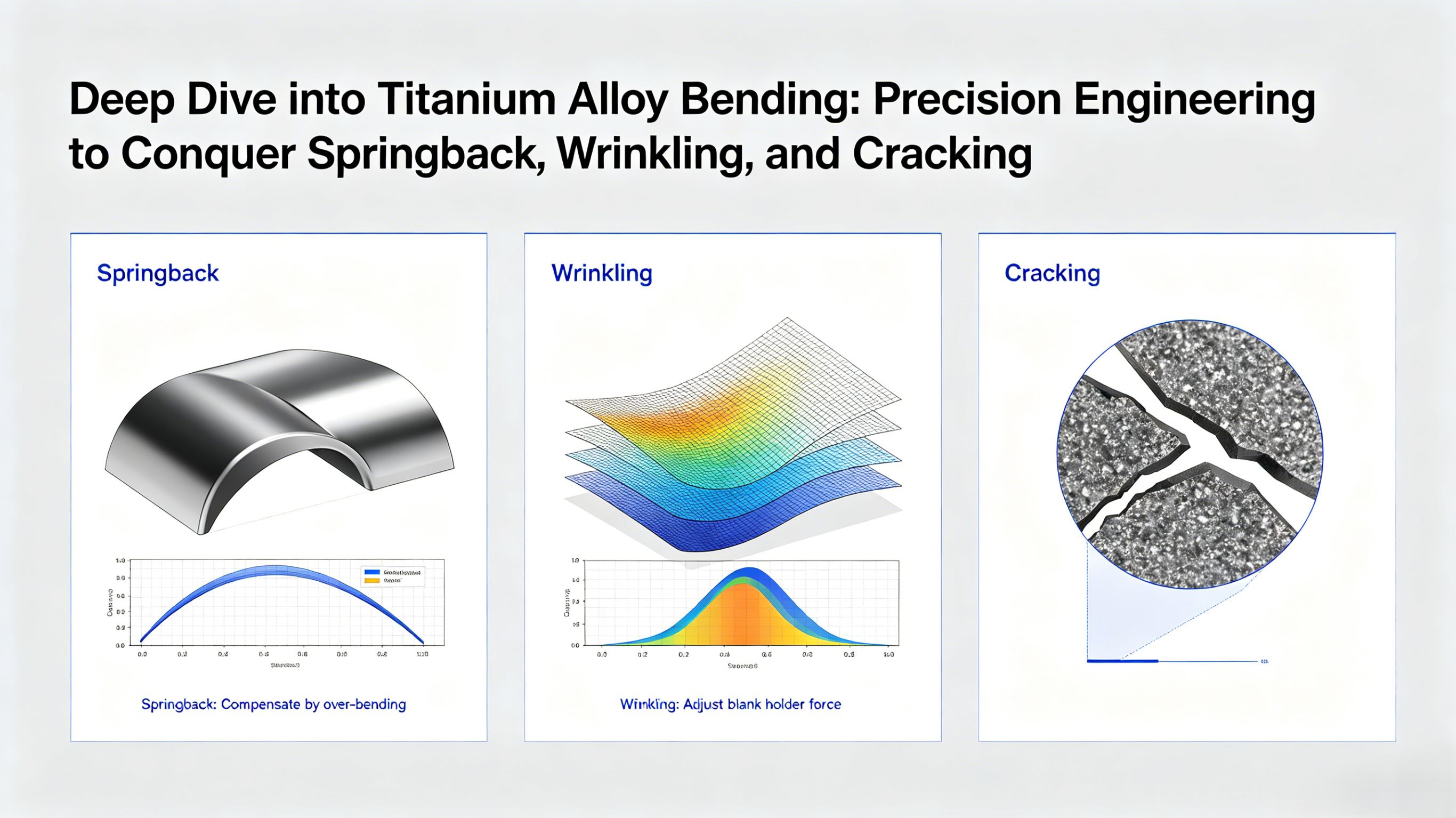
If you've ever looked closely at a high-performance race car's exhaust system or held the handlebar of a top-tier mountain bike, you might notice a common detail: those smooth, curved metal pipes often glow with a pale gold or bluish-gray sheen – the signature "birthmark" of titanium alloy bends.
How does a straight titanium tube become a curved one? And why are so many engineers willing to pay several times the cost to use it? Behind this lies a game of precision between metal and force.
Ⅰ.Straight Tubes Are Easy; Bent Ones Are Hard
There's a saying in titanium processing circles: "Making a straight tube is skill; making a bent tube is mastery." Titanium has a stubborn temperament – it’s extremely springy. If you take a titanium rod and bend it with force, release it, and it almost snaps back to its original shape. That’s the "spring effect" caused by low elastic modulus.
In tube bending, this problem is magnified. During bending, the outer side of the tube is stretched while the inner side is compressed. Steel obediently deforms and stays put, but titanium desperately tries to straighten back. This means that to produce a合格的 titanium bend, engineers must apply a greater bending overage than for steel, accurately calculating the springback angle in a single forming step.
But that’s not the hardest part.
Ⅱ.The Nightmare Called "Wrinkling"
Another characteristic of titanium is its wall-thickness sensitivity. During bending, if the inner side isn’t controlled properly, it can develop accordion-like ripples – that’s wrinkling. Steel might tolerate tiny wrinkles, but on titanium bends, even the slightest wrinkle is a reject.
Why? Because wrinkles become stress concentration points. Under high-pressure gas or fluid flow, they are where cracks start. For aircraft hydraulic lines or race car fuel systems, a hidden wrinkle is a ticking time bomb.
To avoid wrinkling, engineers rely on a mandrel – a flexible metal rod that supports the tube wall from the inside during bending, acting like a die to prevent collapse. At the same time, a clamping die and pressure die apply uniform force from the outside. A high-quality titanium bend is often the result of a coordinated assault between internal mandrel and external dies.
Technical note: The mainstream process today uses CNC tube benders with high-precision mandrels. The bending radius is typically controlled between 1.5 and 3 times the tube diameter (R=1.5D~3D). A radius smaller than 1.5D qualifies as a "tight bend," where yield rates drop sharply, requiring hot bending or specialized fill media (e.g., low-melting-point alloys, wax, or sand).
III. The Weld: An Invisible Lifeline
Another secret of titanium bends lies in the tube wall.
Many titanium bends are made directly from seamless titanium tubes, which offer the best quality but at extremely high prices. For more industrial applications, welded titanium tubes are used – titanium sheets are rolled into tubes, welded into straight pipes, and then bent.
The problem: The microstructure and properties of the weld zone differ from the base metal. During bending, the weld experiences additional tensile or compressive forces. If the weld quality is subpar, it can crack right during the bending process.
Therefore, high-quality titanium bends require strength matching between the weld and the base metal, and during bending, the weld is deliberately positioned at the neutral axis (where forces are minimal). This is typically achieved through weld seam tracking systems or laser positioning. In short, don’t let the weld take the heat.
Ⅳ.Where Do Titanium Bends "Work"?
You may have seen titanium bends in some unexpected places.
-Automotive/motorcycle exhaust systems: Titanium exhaust pipes snake around the engine, suspension, and swingarm. Titanium’s corrosion resistance keeps the exhaust from ever rusting; its lightness sheds several kilograms from the vehicle; and that graceful curve is a status symbol for tuning enthusiasts.
-Bicycle handlebars/frames: High-end mountain bike handlebars, seat posts, and even fully bent seatstays. Titanium bends not only filter road vibration (more韧性 than carbon fiber) but also never need to worry about rust.
-Aircraft hydraulic/fuel lines: Inside wings and fuselages, titanium bends carry critical hydraulic fluid. Aircraft demand smooth, wrinkle-free, pressure-resistant, and lightweight tubing. A single failed bend could prevent landing gear from deploying.
-Chemical/marine heat exchangers: U-shaped titanium bends are the heart of heat exchangers. Seawater corrosion is a death sentence for steel, but for titanium it’s "no problem at all." Titanium U-tubes can operate continuously in seawater for two decades without leakage.
Ⅶ.Bending Is Not the End: The Art of Surface Finishing
Once bent, titanium tubes are sometimes sent for anodizing. By adjusting voltage, the surface can turn gold, blue, or purple. This oxide layer not only looks beautiful but also enhances corrosion resistance and surface hardness.
On some race cars or custom exhausts, you’ll also see burnt-blue marks on titanium bends – natural oxidation colors formed by hot gas passing through. Each streak of blue-purple pattern is unique, like a fingerprint on the titanium bend.
From a straight titanium tube to a smoothly curved bend, the journey must overcome three obstacles: springback, wrinkling, and cracking. But precisely because of these challenges, titanium bends have become a touchstone of industrial manufacturing capability.They aren’t hidden away like fasteners, nor silently carved by machines like gear teeth. Titanium bends are exposed art – you can see their curves, feel their smoothness, and even, in the exhaust fumes, catch a warm, metallic scent.
Next time you’re at a car show and see a sports car with a "titanium exhaust" sticker, crouch down and take a look at that bent tube. It might look casually wrapped around the rear suspension, but every degree of its curve is an engineer’s precise calculation against the spring effect.

Hello, I am the online customer service
